

in collaboration with

Presents at Chillventa 2026:
IREF RF1 | The NET broadband sensor for over 20 refrigerants
A single sensor platform to handle different refrigerant gases, simplifying the development and integration of sensing systems for HVAC/R applications.
You will find NET at
Hall 6 - Booth 6-432
Come meet IREF RF1 and discover how a single broadband platform can simplify the development of refrigerant detection systems.
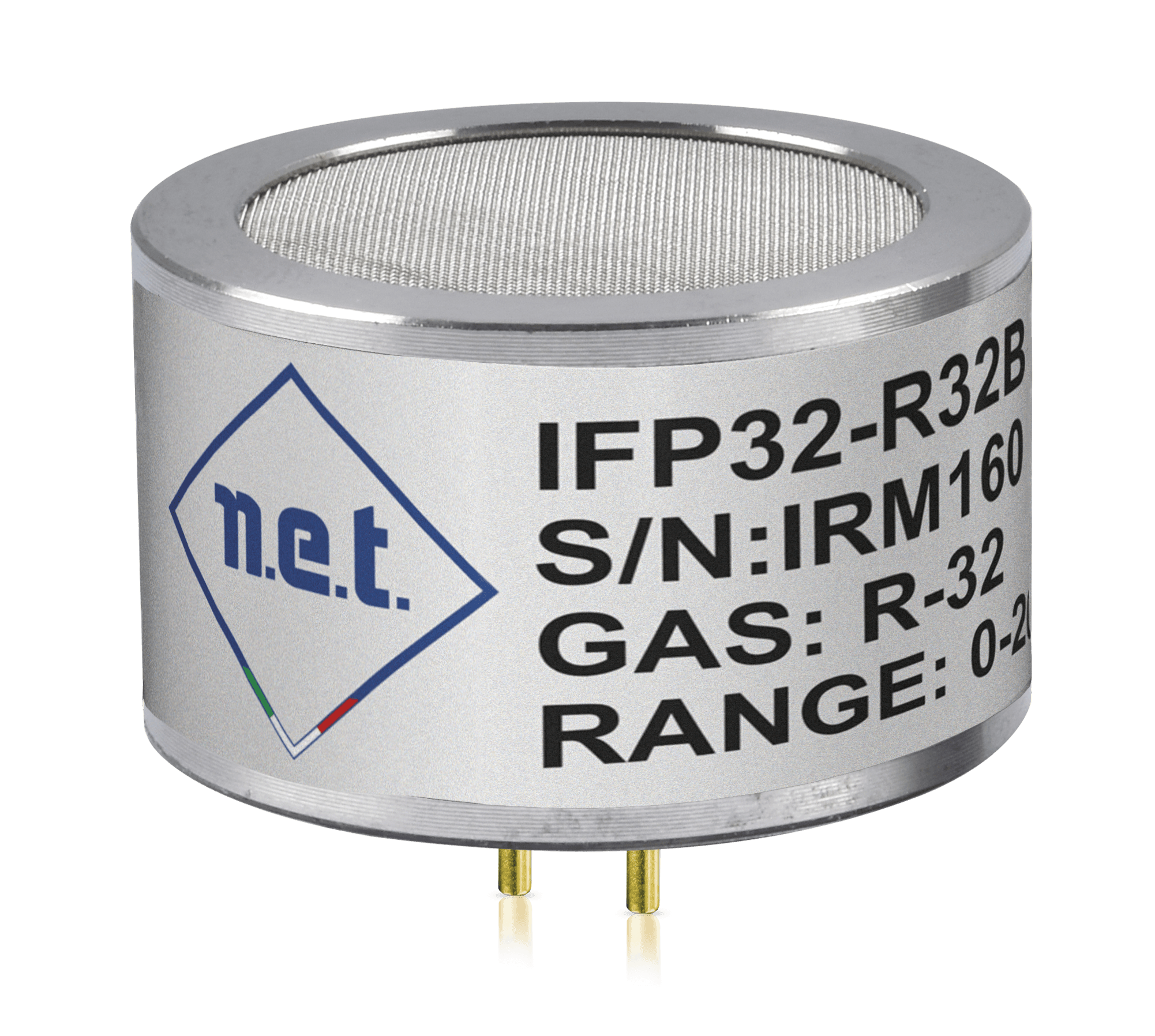
At Chillventa 2026 NET presents IREF RF1 , the new broadband infrared sensor developed for the detection of over 20 refrigerants through a single hardware platform.
The product was created to meet a growing need among OEMs: to develop ranges of detectors capable of working with different refrigerants without necessarily multiplying sensors, product codes and dedicated architectures.
Thanks to the use of predefined cross factors , the same sensing platform can be used in different configurations, maintaining a common sensor format and interface.
IREF RF1 in summary
A compact platform designed to combine configuration flexibility, rapid response times and simplified integration.
20+
Refrigerants manageable via cross factor
0–2000 ppm
Measuring range
T90 ≤ 30 s
Response time
32 mm
Industrial format of the platform
One platform for multiple configurations
IREF RF1 was created to reduce the fragmentation that can occur when a family of detectors needs to be developed for different refrigerants.
In traditional architectures, different gases may require dedicated sensor versions, different calibration procedures, and multiple part numbers .
NET's broadband approach instead allows for building different configurations around a common hardware platform, leveraging predefined cross factors to adapt the sensing to the expected refrigerant.
The same sensor format and interface can therefore be maintained across different detector variants, helping to simplify design, range management and integration.

For OEMs this means
Less complexity, more design continuity
Fewer sensor versions to manage
Reduction of product codes
Greater consistency between different detectors
Less need for redesign
Easier platform to integrate
NDIR dual beam technology
The broadband architecture combines NET's NDIR technology with spread-spectrum emitters and receivers and internal signal processing.
NDIR dual beam
The measuring principle uses the absorption of infrared radiation to detect the presence and concentration of the refrigerant gas.
Internal microprocessor
Internal signal processing allows for an already linearized and temperature-compensated output.
Analog output
Available with standard voltage output, facilitating integration into different sensing architectures.
Modbus communication
Digital communication offers an additional integration option for manufacturers of sensing instruments and systems.
Designed for integration into sensing systems
The 32 mm industrial format and the different output options allow IREF RF1 to be integrated into detectors intended for refrigeration, HVAC and heat pump applications.
Industrial format
The 32mm platform is designed for easy integration into existing detectors and architectures.
Temperature compensation
Each sensor is individually calibrated and uses internal compensation to maintain performance as temperatures vary.
Robust construction
The stainless steel housing is developed for use in industrial applications and professional detection systems.
Technical features for professional applications
IREF RF1 integrates features designed for reliability, durability and reduced maintenance activities.
SIL2
Available in configurations dedicated to functional safety
≥ 5 years
MTBF declared
1 year
Calibration interval
-20 / +50 °C
Operating temperature range
Learn more about IREF RF1
See the full datasheet for detailed electrical and mechanical specifications, performance, digital communications, certifications, and available options.
Download the technical sheet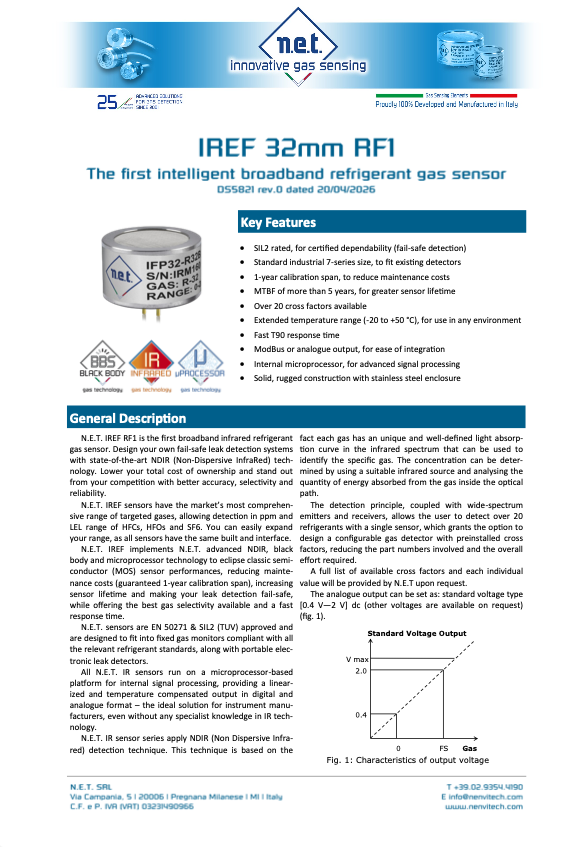
Discover IREF RF1 at Chillventa 2026
Hall 6 - Booth 6-432
Talk to the NET team and learn how broadband sensing can help simplify the development of multi-refrigerant detectors.
FAQ